
 In 2006, the Western Australian Department of Education and Training (DETWA) published its study, Teacher ICT Skills: Evaluation of the Information and Communication Technology (ICT) Knowledge and Skill Levels of Western Australian Government School Teachers . The purpose of the study was fourfold:
The study sought to discover how highly skilled teachers were in terms of basic ICT competencies as well as how well teachers integrated their ICT competencies into their everyday teaching and professional practice. |
|
 One way of viewing teacher competencies is to define them as a set of personal skills that are required for best practice use of ICT in education. Accordingly the DETWA study does separate the concept of acquired technological skills (competence) from a teacher's ability and willingness to integrate personal ICT skills in teaching and professional practice.
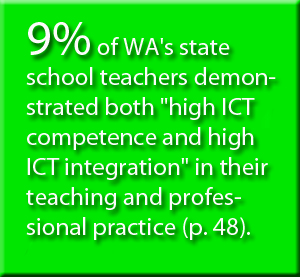
Since the study does recommend that the 9% of teachers who operate at high levels on both scales be considered for leadership roles within schools, there is some merit in defining some of the attributes the highest functioning teachers were found to possess as being desireable teacher competencies.
ICT skills and knowledge
|
|
 Multimedia competencies
As of 2006, only 9% of state school teachers demonstrated high generic ICT skills coupled with an ability and willingness to integrate those skills into the full spectrum of professional practice. Teacher competencies in Western Australia will be addressed, no doubt, but the present circumstance does not bode well for creative use of multimedia in secondary education since many more competencies, specific to the creation and skilled use of multimedia, are required. Many applications are now available on the Web that take the place of more traditional tools that require a degree of training that would not be reasonable to expect of most teachers. For example, blah blah give the following list of traditional tools assoicated with skilled creation of multimedia. I have highlighted some web-based alternatives that require far less training to use, and can often be self taught:
|
|
