
Guidelines for use of multimedia in education must be made within some metaphysical world view of what actually constitutes good educational practice. Even if the existence of such a philosophical framework is not acknowledged or made explicit, the development of guides to best practice in education depend on underlying ontological and epistemological beliefs that steer decisions().
In practice, teachers develop ideas about what constitutes good education from memories of their own schooling and what worked best for them, formal training, professional practice and experience gained 'on the ground,' ongoing professional development, the cultural climates of the schools or educational facilities in which they work, and through leadership provided.
For the purposes of this discussion, best educational practice provides opportunity for all students to engage in deep learning at all times, but acknowledges that strategic choices between deep and surface learning strategies take place. Guided instructional methods such as those required by age appropriate scaffolding, delivery of syllabus, requisite or set curriculum requirements to given deadlines, guidance through bridging or remedial training towards emancipatory ends are utilised in most formal educational contexts. That said, the best use of multimedia in a teaching and learning environment proceeds with a goal to facilitate student centred learning and the development of lifelong learning skills using constructivist approaches to teaching and learning. This framework has implications to how multimedia can best be used to achieve certain specific goals:
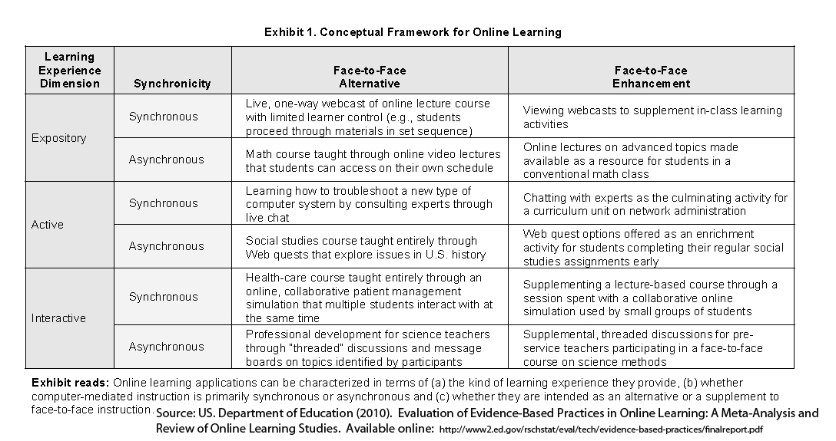
|
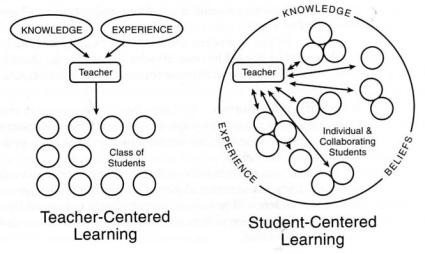

|
|
- convenience is achieved when students can access the learning activities at convenient times.
- efficiency is described as not having to attend on campus classes and therefore allowed for efficient use of time.
- autonomy is described as allowing students to decide when and how to access the curriculum. (Tobin, 1998:151)
Simonson et al, 2006, p. 202. http://www.mrsroemmich.com/manual/topics/content/
Use of taxonomies and instruments to evaluate multimedia
Tools exist that can be used to assess educational design that involves use of multimedia. These tools may be useful to assess a pre-existing course design, and can also be use to help plan and evaluate design selections. These tools can also aid in brainstorming.
Taxonomies -- Using it for design allows implementers, as they develop new materials, to consider the available media forms and formats. Designers often consider issues of metaphor, interaction, cognitive accessibility, and the use of media. (Heller et al, 2001 p. 4)
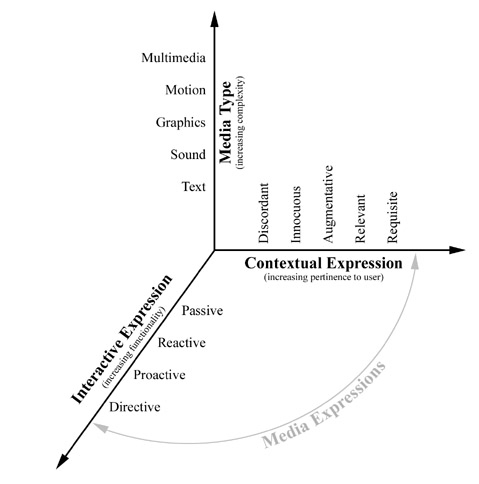 T-MUM (Taxonomy of Media Use in Multimedia) (Williams, 2003 p ) | Instruments
|
Chang, V., & Fisher, D. L. (1998). The validation and application of a new learning
environment instrument to evaluate online learning in higher education.
Retrieved 31 July, 2003, from http://www.aare.edu.au/01pap/cha01098.htm
Chang, V., & Fisher, D. L. (2003). The validation and application of a new learning
environment instrument for online learning in higher education. In M. S.
Khine & D. L. Fisher (Eds.), Technology-Rich Learning Environments A
Future Perspective (pp. 1-20). Singapore: World Scientific Publishing Co.
Pte. Ltd.
Adams, N.B., DeVaney, T.A., & Sawyer, S.G. (2009). Measuring Conditions Conducive
to Knowledge Development in Virtual Learning Environments: Initial Development of a Model-Based Survey. Journal of Technology, Learning, and Assessment, 8(1). Retrieved [date] from http://www.jtla.org
